
A laptop power bank sounds simple until the numbers start lying by omission. A big capacity number does not automatically mean your laptop gets a full extra workday. A high wattage number does not help if the cable, laptop, or port negotiation cannot use it. The useful question is narrower: will this bank cover the specific device and trip you actually have?
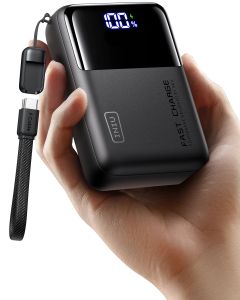
The INIU Cougar P63 25,000mAh Laptop Power Bank is a good concrete example because it sits in the serious-but-still-packable category: larger than a phone emergency bank, smaller than a portable power station, and aimed at people who charge laptops, tablets, handheld consoles, cameras, and phones on the same day.
The numbers that matter
| Spec to check | Why it matters | What not to assume |
|---|---|---|
| 25,000mAh capacity | Enough stored energy to be useful beyond phones and earbuds | It does not equal a guaranteed full laptop recharge. |
| 100W-class USB-C output | Can support many USB-C laptops that need more than phone-charger power | Your laptop, cable, and port still have to negotiate the right profile. |
| Multiple ports | Useful for phone + tablet + headphones + laptop days | Total output may be shared when several devices are connected. |
| Recharge speed | A bank this size is only convenient if it can be recharged between travel days | The wall charger used to recharge it matters too. |
| Airline compatibility | Power banks are treated as spare lithium batteries | Do not throw it into checked luggage without checking current rules. |
Who should compare the INIU Cougar P63
Compare the INIU Cougar P63 if your travel day includes more than a phone. It makes sense for remote workers, students, photographers, handheld gaming users, drone-adjacent camera bags, conference days, and road trips where outlets are uncertain.
It is less compelling if your only problem is topping up a phone at dinner. In that case, a thinner 10,000mAh bank is easier to carry and cheaper to replace. A 25,000mAh laptop bank earns its space when one dead laptop, tablet, hotspot, or console would ruin the day.
The cable and charger problem
Many people buy a high-output bank and then use a weak cable. That is the quiet failure point. A 100W-capable power bank needs a USB-C cable that can carry the expected wattage, and the laptop must accept USB-C Power Delivery at a useful level. If the laptop normally uses a proprietary barrel charger, check the manufacturer’s USB-C charging support before assuming this solves anything.
The same logic applies when recharging the power bank itself. A large bank recharged from a small phone brick can feel painfully slow. If the goal is travel resilience, treat the wall charger and cable as part of the system.
Where the TESSAN adapter fits
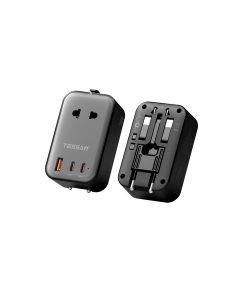
A power bank solves stored energy. It does not solve foreign outlets. That is where the TESSAN Ultra Thin Universal Travel Adapter PD 20W becomes the quiet partner: compact plug adaptation plus USB-C/USB-A charging for smaller devices.
The pairing is practical, but the limitation matters. The TESSAN adapter is not a voltage converter. It is best for dual-voltage electronics and USB charging, not single-voltage high-power appliances. For laptop travel, the safest path is usually a dual-voltage laptop charger plugged through the adapter, plus a power bank for unplugged work.
What this purchase should not solve
A laptop power bank is not a replacement for every other travel-power decision. It will not make a foreign wall outlet fit, it will not turn an incompatible appliance into a safe one, and it will not remove the need to carry the right charger and cable. Keep the purchase narrow: the INIU is for stored USB-C power; the adapter and wall charger solve different parts of the trip.
Pre-buy checklist
- Check your laptop’s USB-C charging wattage and whether it supports Power Delivery.
- Use a cable rated for the wattage you expect.
- Check the power bank’s watt-hour rating before flying.
- Decide whether you need phone backup, laptop backup, or both.
- Compare the bank against a smaller 10,000mAh model; if the smaller one solves the trip, do not overbuy.
FAQ
Will a 25,000mAh power bank fully charge my laptop?
Maybe, but do not assume it. Laptop battery size, workload, conversion loss, charging wattage, cable quality, and whether the laptop is being used while charging all change the result.
Is 100W necessary?
It is useful for many laptops and handheld setups, but unnecessary for phones and earbuds. Buy the wattage for the most demanding device you actually carry.
Can I fly with a 25,000mAh power bank?
Check the watt-hour rating on the exact listing and compare it with the airline’s battery policy before packing. Treat the bank as carry-on travel gear, not something to bury in checked luggage.
Should I buy a travel adapter or a power bank first?
If the trip is international, the adapter solves the outlet problem. If the trip is long, remote, or outlet-poor, the power bank solves the runtime problem. Many serious travel kits need both.
The bottom line
The INIU Cougar P63 is interesting because it sits at the point where a power bank stops being only a phone accessory. Buy it if your real problem is laptop-class travel power; skip it if a smaller pocket bank already covers your day.
Reference points checked: INIU official P63 page, FAA PackSafe battery guidance, TESSAN official adapter page.
As an Amazon Associate we earn from qualifying purchases.
Comments