
Short answer: choose a full-size room air purifier when you need published CADR and room coverage for a bedroom, office or living area. Choose a portable purifier only for a small personal zone near a desk, bedside table or temporary space. A compact “desktop” unit is not the same thing as a whole-room purifier, and neither option replaces ventilation, source control, maintenance or medical care.
Air purifier vs standing desk: they solve different problems
If you are comparing an air purifier with a standing desk, the practical difference is simple: a standing desk changes posture and movement habits, while an air purifier filters air in a defined space. One does not replace the other. For a home office, start with the problem you can actually name: sedentary time, back-and-leg comfort and work routine point toward a desk or movement setup; dust, smoke, pollen, odour or verified room-air concerns point toward filtration, ventilation and source control.
If movement is the real problem, read our walking pad vs under-desk elliptical guide before buying another appliance. If air quality is the problem, keep the decision tied to published CADR, room size, filter replacement cost and whether the exact model uses an ionizer or ozone-producing feature.
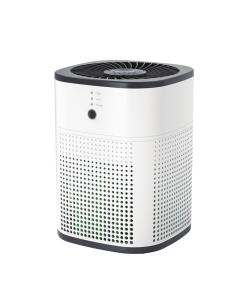
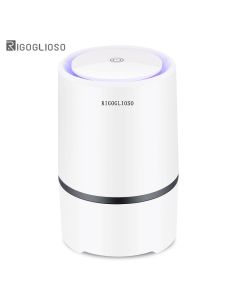
Our current catalog identifies one larger air purifier and one portable ionizer-style purifier. It does not publish a verified CADR, room-size rating, filter class or ozone-emissions result for either listing. That makes the honest recommendation conditional: use the products as starting points, then confirm the exact merchant specification before treating either as suitable for a particular room.
Choose the room job, then check the published data
| Situation | Practical starting point | Published data to verify | Do not assume |
|---|---|---|---|
| Shared bedroom, home office or living room where the unit can stay in one place | Larger catalog purifier | Published CADR, room size at the stated ceiling height, filter replacement cost, noise and unobstructed intake | That a larger body proves performance without a CADR or a published room rating |
| Personal desk, bedside table or compact temporary space | Portable catalog purifier | Whether it is intended for that small area, operating method, power needs, noise and what it filters | That “portable” means it can clean an entire room or replace ventilation |
| Odours, smoke or gaseous pollutants are the concern | Compare products with a published gas-filtration design | Whether the model includes material intended for gases, not only particles | That a particle CADR proves gas or odour removal |
| You are choosing around allergies, asthma, mould or other symptoms | Start with source control and professional advice where needed | The actual cause, cleaning/repair needs and a product’s verified scope | That an appliance diagnoses, treats or fixes a health condition or moisture problem |
For a room purifier, CADR is the missing number to ask for
Clean Air Delivery Rate (CADR) is a particle-filtration measure used to compare portable room air cleaners. ENERGY STAR and the U.S. EPA both advise matching a published CADR to the intended room size; their guidance also notes that ceiling height, fan speed and placement matter. A unit marketed as “99.97% effective” may be describing filter media or a particular test condition, not the amount of clean air delivered to your room. Ask for the exact CADR, its particle category and the room-size claim before using a marketing percentage as a buying decision.
The larger catalog purifier is a reasonable category to investigate for a fixed bedroom, office or shared area because the page positions it for those routines. But the listing alone is not enough to state a room size or performance level. Check the manufacturer label or merchant documentation, measure the room, leave airflow around the intake and outlet, and include filter replacement in the total cost. A good unit can still disappoint when it is undersized, blocked by furniture or run only briefly at a low setting.
Portable and ionizer-style units need a narrower claim
A compact device can be convenient near a workstation or bedside, especially when floor space is scarce. That convenience is not evidence that it serves a whole apartment, a car cabin or a large open-plan room. The portable catalog listing identifies it as an ionizer-style product but does not currently provide the operating details needed to judge output or emissions. Do not buy it for a specific air-quality target until the exact product page states how it works and what it is designed to filter.
The EPA cautions buyers to avoid air cleaners that intentionally produce ozone, a lung irritant, and says that some ionizing or electronic designs may have potential to emit it. This is not a diagnosis of the catalog product; it is the reason to verify the exact model’s documentation before placing an ionizer-style device in a bedroom, near children or beside someone with a respiratory concern. When health symptoms are involved, an appliance is not the place to self-diagnose or delay professional care.
Placement and upkeep decide whether a good specification helps
- Measure the room or personal area and note ceiling height.
- Find the exact model’s CADR, stated room size, particle/gas filtration design and filter schedule.
- Place it where the intake and outlet are not blocked by curtains, a wall or furniture.
- Run it at a setting you can sustain, then replace or clean components exactly as the manufacturer directs.
- Address obvious sources—smoke, moisture, damaged materials or poor cleaning practices—rather than asking the appliance to solve them alone.
What not to assume
- Do not treat a HEPA-style phrase, a percentage claim or a compact size as a published room-performance rating.
- Do not assume a purifier removes every pollutant, fixes mould or replaces source control and ventilation.
- Do not assume a CADR for particles measures performance against gases or odours.
- Do not assume an ionizer is appropriate until its exact emissions and operating method are documented.
Questions buyers ask
Should I choose a portable purifier or a larger room unit?
Choose by the space and the verified performance data. A portable unit can suit a personal small-area routine; a larger unit can suit a fixed room if its published CADR and room rating match the space.
What CADR should I look for?
Use the exact room area, ceiling height and the manufacturer’s published rating. ENERGY STAR provides sizing estimates for standard eight-foot ceilings, but the product’s own documentation remains essential.
Can an air purifier fix mould or persistent odours?
No. Filtration may reduce some airborne particles, but a moisture or mould problem needs the underlying cause addressed. Check the product’s gas-filtration claims separately for odours.
Are ionizer-style purifiers always safe?
Do not generalise. Verify the exact model’s operating method and documentation. The EPA cautions against devices that intentionally produce ozone.
Sources and checks before buying
- ENERGY STAR air-cleaner sizing and CADR guidance
- U.S. EPA guide to air cleaners in the home
- For either linked catalog product, verify the exact current merchant page for CADR, room rating, filter type, maintenance and operating method before ordering.
Some product links are affiliate links. We may earn a commission from qualifying purchases, at no extra cost to you.
Comments