
Short answer: these three cameras solve three different creator problems. DJI Osmo Pocket 4 is the strongest conventional choice when image quality, long handheld runtime and a predictable gimbal workflow matter most. DJI Neo 2 is the better fit when autonomous aerial follow shots are the point. HOVERAir VERSA is the most unusual concept because the same camera can work as a handheld 3-axis gimbal and, with the Flight Kit, as a self-flying camera.
That makes VERSA genuinely interesting, but it also creates the biggest buying caveat in this comparison: U.S. availability is not the same as availability elsewhere. Reporting in August 2026 said the FCC set aside VERSA's U.S. equipment authorization and that HOVERAir stopped offering Flight Kit configurations to U.S. buyers. If you are in the United States, verify the exact configuration that can legally be ordered and shipped before backing the campaign. The comparison below therefore treats VERSA as an innovative crowdfunding product, not as a normal U.S. retail alternative that is guaranteed to arrive with flight hardware.
The fast decision
| Your priority | Best starting point | Why |
|---|---|---|
| Best all-around handheld creator camera | DJI Osmo Pocket 4 | 1-inch sensor, 3-axis gimbal, 4K/240 maximum video mode, 107 GB internal storage and long quoted runtime. |
| Compact autonomous flying shots | DJI Neo 2 | 151 g drone with 4K/60 video, subject tracking, palm operation and omnidirectional obstacle sensing. |
| One camera that can switch between handheld and flight | HOVERAir VERSA | The modular idea is the differentiator: use the camera handheld, then attach the Flight Kit where the configuration is available and legal. |
| U.S. buyer who wants the least regulatory ambiguity | DJI Osmo Pocket 4 | It is a handheld camera, not a drone. VERSA's Flight Kit has faced a specific U.S. FCC problem, while drone rules still apply to Neo 2. |
| Fastest way to capture yourself without a camera operator | DJI Neo 2 or VERSA | Both are designed around automated subject capture; VERSA adds a handheld mode, while Neo 2 is the more conventional drone product. |
| You hate switching between camera types | HOVERAir VERSA | This is exactly the problem its modular architecture is trying to solve. |
What HOVERAir VERSA is actually trying to replace
VERSA makes more sense when you stop thinking of it as "another tiny drone." The core idea is that a creator may carry a stabilized handheld camera for walking shots, talking-to-camera clips and travel footage, then want an autonomous aerial angle a few minutes later. Normally that means carrying two devices. VERSA tries to make the camera module itself the constant and turn flight into an attachment.
HOVERAir's campaign lists a 3-axis gimbal, 4K/60 recording, 10-bit HDR, 64 GB of built-in storage plus microSD expansion, and a total weight of about 230 g when configured to fly. The company quotes up to 14 minutes of flight time and roughly three hours of handheld shooting per battery. The Flight Kit attaches through the company's MagLatch system, while automated modes handle the kind of follow, orbit and reveal shots for which HOVERAir is known.
There is an important limitation that belongs near the top of any serious buying guide: VERSA does not use active obstacle avoidance in the way many buyers may assume when they hear "AI flying camera." HOVERAir says its ShadowTrack system predicts movement, but the campaign FAQ also states that VERSA does not actively sense obstacles, brake or steer around them. Clear flying space still matters.
Check the current HOVERAir VERSA campaign, reward tiers and shipping terms →
VERSA vs Osmo Pocket 4: flexibility vs image-first simplicity
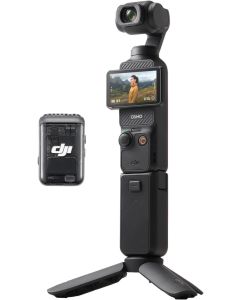
DJI Osmo Pocket 4 is the easier camera to understand. DJI gives it a 1-inch CMOS sensor, a 20 mm-equivalent f/2.0 lens, full-pixel PDAF autofocus, a 3-axis mechanical gimbal and a maximum 4K/240 recording mode. It also has 107 GB of internal storage and DJI quotes up to 240 minutes of operation under its test conditions.
That does not automatically mean every Pocket 4 clip will look better than every VERSA clip. Lighting, stabilization mode, framing, exposure and how aggressively each camera processes the image all matter. But the hardware direction is clear: Pocket 4 is built first as a dedicated handheld imaging tool. VERSA is built first around versatility.
If your work is mostly city travel, food, events, family, walk-and-talk video, product footage or creator content where you stay on the ground, Pocket 4's simplicity is a major advantage. There is no wing module to carry, no flight environment to evaluate and no drone regulation to check before getting the shot. Pull it out, frame, track and record.
VERSA becomes more compelling when the shot you want changes during the day. A handheld sequence can become a self-following shot or an elevated reveal without changing camera systems. That is not a small feature; it changes how you plan a shoot. The cost is that you are accepting a younger crowdfunding product, shorter flight runtime and more regulatory complexity.
VERSA vs DJI Neo 2: two very different ideas of a creator drone
Neo 2 approaches the problem from the other direction. It is a drone that has been made easier to use for everyday creators. DJI lists a takeoff weight of 151 g, 4K/60 video, 4K/100 slow motion, a 2-axis gimbal, 49 GB of internal storage, palm takeoff and landing, gesture control, ActiveTrack and omnidirectional obstacle sensing. Maximum quoted flight time is 19 minutes.
Neo 2 therefore has two practical advantages over VERSA as a flying product. First, it is designed as a complete drone rather than a camera plus detachable flight module. Second, its obstacle-sensing hardware is a meaningful safety and usability feature for beginners. No avoidance system makes careless flying safe, but having dedicated sensing is materially different from having none.
VERSA's advantage is what happens before and after the flight. Neo 2 does not become your stabilized handheld camera when it lands. VERSA can. If your ideal travel kit is literally one camera module that follows you in the air and then sits on a mini tripod or works as a handheld gimbal, VERSA is the more original answer.
If your priority is simply "I want a small drone that can follow me," Neo 2 is the more straightforward category match. If your priority is "I want fewer separate cameras in my bag," VERSA is the more interesting architecture.
The U.S. issue changes this comparison
For buyers outside the United States, the comparison can stay mostly about hardware and workflow. For U.S. buyers, it cannot. Multiple reports published after VERSA's launch said the FCC determined that the equipment authorization had been granted in error and set it aside. Reporting also indicated that configurations containing the Flight Kit stopped being offered to U.S. customers.
That matters because the Flight Kit is not a side accessory to the premise of this product; it is what turns VERSA into the flying camera described in the campaign. A camera-only VERSA can still be an interesting compact gimbal, but then it is competing much more directly with Pocket 4 and loses the feature that makes this comparison unusual.
Do not use an old campaign screenshot, launch article or search snippet as proof that a given VERSA bundle can ship to your address today. Open the live campaign, select your country and verify exactly what is included. Crowdfunding availability can change faster than a normal retail product page.
Image quality: do not buy from one headline number
Pocket 4's 1-inch sensor is its clearest hardware advantage for buyers who care most about conventional camera performance. DJI also advertises 14 stops of dynamic range and 10-bit D-Log. VERSA's campaign promotes a 1/1.3-inch 12 MP sensor, 10-bit HDR and a claimed 17.5-stop dynamic-range figure. Those numbers are not directly interchangeable across manufacturers and test methods, so we would not declare a dynamic-range winner from marketing figures alone.
Neo 2 uses a 1/2-inch 12 MP sensor and f/2.2 lens. Its value proposition is less about maximum sensor area and more about putting the camera somewhere a handheld gimbal cannot go. That distinction matters. A smaller flying camera can produce the better clip when the composition itself is impossible from the ground.
Think about footage, not spec-sheet trophies. Pocket 4 is the safest choice for handheld low-light scenes, controlled composition and long recording sessions. Neo 2 is the aerial specialist. VERSA is the hybrid whose value comes from moving between those roles.
Travel: which one earns space in the bag?
For pure physical packing, all three are compact by creator-camera standards, but they impose different kinds of overhead.
- Osmo Pocket 4: simplest single-device carry. Add a microphone or small tripod if your workflow needs them.
- DJI Neo 2: light aircraft, but a drone still brings batteries, charging, local flight restrictions and potentially a controller depending on how you want to use it.
- HOVERAir VERSA: potentially the most efficient two-in-one kit, but only if you can actually use the Flight Kit where you travel. Otherwise you are carrying modularity you cannot exploit.
Travel is where VERSA's idea is strongest conceptually. It is also where regulatory research matters most. Drone rules vary by country and location, and being under 250 g does not mean "no rules." HOVERAir's own FAQ lists different certification and operator requirements by region.
Crowdfunding risk is part of the product
VERSA is not being evaluated here as if it were a mature camera sitting on a retail shelf with years of buyer history. It is a crowdfunding campaign. HOVERAir says shipping begins in October 2026 and shows production-testing material, but backing a campaign is still different from buying a normal stocked product.
Before pledging, check the exact reward, expected ship date, shipping fee, customs treatment, refund terms and what happens if certification changes in your destination market. The campaign FAQ currently says U.S., Canada, UK, EU, Australia and New Zealand shipping fees are US$49, while other regions vary. Those terms can change, so the live campaign is the authority at checkout.
The upside of crowdfunding is early access to a genuinely novel camera design. The downside is that novelty includes execution risk. That trade-off should be explicit, not hidden behind an enthusiastic product card.
Who should choose each camera?
Choose HOVERAir VERSA if...
- You specifically want one camera system for handheld and autonomous flying perspectives.
- You are comfortable backing a crowdfunding product and checking current regional availability.
- You mostly shoot yourself, travel, outdoor activities or moving subjects where automated capture helps.
- You understand that VERSA does not provide active obstacle avoidance.
Choose DJI Osmo Pocket 4 if...
- Handheld image quality and predictable creator workflow come before aerial shots.
- You want a larger sensor, long quoted battery life and high-frame-rate 4K options.
- You want to avoid drone rules entirely.
- You record long travel days, interviews, events, food, products or walking footage.
Choose DJI Neo 2 if...
- You want the flying part more than the handheld-camera part.
- Palm operation, tracking and obstacle sensing matter.
- You want a more conventional drone product with a defined controller/accessory ecosystem.
- You already have another camera for ground footage.
What we would do
For a creator buying one camera today, Osmo Pocket 4 is the least complicated recommendation: it is purpose-built for handheld capture and avoids the flight-specific uncertainty surrounding VERSA in the U.S. For someone who knows they want aerial tracking, Neo 2 is the cleaner drone decision.
VERSA is the one we would keep watching because it is trying to collapse those two purchases into one modular system. That makes it more exciting than a minor annual camera refresh. But the correct recommendation depends heavily on country. Outside the U.S., VERSA can be evaluated as the full handheld-plus-flight idea. In the U.S., verify the campaign's current configuration before treating the Flight Kit as part of the purchase.
If you already know you prefer a conventional pocket gimbal, Anagramshop currently carries the DJI Osmo Pocket 3 Creator Combo, which remains a useful lower-generation reference point while Pocket 4 availability expands. If you want a completely different creator workflow, our GoPro Mission 1 Pro vs Insta360 X5 vs DJI Neo creator-camera comparison looks at action, 360 and flying-camera setups from another angle.
FAQ
Is HOVERAir VERSA a drone or a gimbal camera?
Both, depending on configuration. The VERSA camera works handheld on a 3-axis gimbal and can attach to a Flight Kit that turns it into a self-flying camera where that configuration is offered and legal.
Can HOVERAir VERSA ship with the Flight Kit to the United States?
Do not assume that it can. Reporting after launch said the FCC set aside VERSA's equipment authorization and that HOVERAir stopped offering Flight Kit configurations to U.S. buyers. Check the live campaign for your shipping country before pledging.
Does HOVERAir VERSA have obstacle avoidance?
No active obstacle avoidance is claimed in the campaign FAQ. HOVERAir says ShadowTrack predicts movement, but the product does not actively sense obstacles, brake or steer around them. Fly only in suitable open environments.
Is Osmo Pocket 4 better than HOVERAir VERSA?
It is the stronger conventional handheld-camera choice on paper, with a 1-inch sensor, 3-axis stabilization, 4K/240 maximum recording, 107 GB internal storage and long quoted runtime. VERSA's advantage is not beating Pocket 4 at being a normal gimbal camera; it is adding a detachable self-flying mode.
Is DJI Neo 2 better than VERSA for flying?
Neo 2 is the more conventional small-drone product and adds omnidirectional obstacle sensing, 4K/60 video, a 2-axis gimbal and up to 19 minutes of quoted flight time. VERSA is more interesting if you value the same camera switching back to handheld mode after landing.
How long can HOVERAir VERSA fly?
HOVERAir quotes up to 14 minutes of flight time per swappable battery and up to three hours in handheld use. Real runtime depends on conditions, settings, temperature and battery health.
How much does HOVERAir VERSA cost?
The campaign launched with early-bird pricing starting around US$449, but reward tiers, bundles and regional pricing change. The full flying configuration costs more than a camera-only tier. Use the live Indiegogo reward list rather than an old launch price before deciding.
Which one is best for travel?
Pocket 4 is simplest if you mainly film on the ground. Neo 2 makes sense if aerial shots are essential and you are comfortable with drone rules. VERSA could be the most space-efficient hybrid if the Flight Kit is available in your destination market and you genuinely use both modes.
The useful verdict
HOVERAir VERSA is the most interesting idea, DJI Osmo Pocket 4 is the safest creator-camera choice, and DJI Neo 2 is the cleaner flying-camera choice. The point is not to crown one universal winner. The point is to decide whether your missing shot is on the ground, in the air, or caused by carrying two separate devices.
VERSA deserves attention because it attacks that last problem directly. If HOVERAir delivers the hardware well and the product is legally available in your market, the handheld-to-flight transition could be genuinely useful rather than gimmicky. For U.S. buyers, however, the FCC situation is not a footnote: verify current eligibility and bundle availability before backing.
View the current HOVERAir VERSA campaign →
Sources checked October 6, 2026: HOVERAir VERSA Indiegogo campaign and FAQ, DJI Osmo Pocket 4 official store/specifications, DJI Neo 2 official store/specifications, The Verge reporting on VERSA U.S. FCC status, and DroneXL reporting on the FCC authorization being set aside.
As an Amazon Associate we earn from qualifying purchases on eligible linked products.
Comments